
Piano Course
The McClintock Piano Course: A New Experience in Learning
INTRODUCTION
Have you ever set out to do something and found, after you finished, that you had been so intent on the goal of “getting it done” that you had missed the experience of doing it? Doesn’t this frequently happen when we set out to learn something? We would prefer to “already know,” and therefore, we are apt to impatiently rush ahead, thus depriving ourselves of the joy of the experience of learning.
We often think of learning or of “getting an education” as a means to an end, and we may have a tendency to look upon the process of learning as a kind of drudgery to be endured until we have arrived at our goal. In school, did you ever have as your sole aim the grade or credit? And instead of enjoying the experience of learning, did you frantically stuff your mind with facts and formulas and data and rules, thereby limiting the experience to one of mentally cataloging information so that you would know all the right answers? Of course, such an experience is totally superficial, and after the examination, we seldom remember what we “learned.”
The real purpose of education is quite the opposite. The word educate comes from the Latin word educare, meaning “to draw out” or “to bring forth.” The word “education” is one of the most significant and powerful words in our language, because it implies that there is already something within us to be drawn out. The poet Robert Browning gave us the secret, when he wrote:
From outward things, whate’er you may believe.
… and, to know,
Rather consists in opening out a way
Whence the imprisoned splendor may escape,
Than in effecting entry for a light
Supposed to be without.”
—-From Paracelsus
Inherent in each of us are principles and truths that can be awakened and drawn out through every realm of experience. Throughout this Course, you will be developing a musical consciousness by responding to principles as they apply to the study of music. As you respond to a principle, your awareness will increase and expand, and you will find that there are unlimited applications of the same principle to other areas of your daily life. And to the degree that your awareness increases and expands, each experience will become deeper, broader, and richer.
“In this Course, you will be given all the principles that I have discovered, and you will be led in a simple and direct way through the application of those principles as each experience of your study unfolds. Often you may find yourself saying something like: “Why, of course, that is true! I never thought of it in quite that way before.” And then you will know that you have responded to a principle. I hope you will find, during your study of this Course, that the act of learning — every stage of it — can be one of the most joyous and fulfilling experiences you have ever had.”
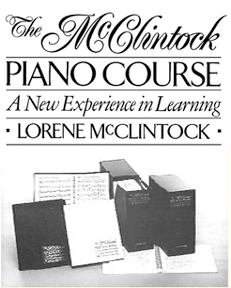 The McClintock Piano Course: A New
 Experience in Learning
What Is “The McClintock Piano Course”?
The Course comprises 201 lessons. The music and text are arranged in progressive order for use by teachers as well as by individuals for self study in their own homes. It consists of 3 volumes of music and 8 volumes of corresponding text, plus the McClintock Keyboard Concealer and the McClintock Interval Keyblocks.The Course is packaged in two handsomely boxed sets.
The Course requires no previous knowledge of music or the keyboard.
A piano is not required when the student begins the Course. The student is taught to create his own keyboard in his imagination, and therefore, he is able to practice in the air or on any flat surface. As a matter of fact, it is recommended that the student practice each lesson on an imaginary keyboard before going to the piano. The text of the Course is a guide that engages and inspires students, leading them step by step through a series of procedures that enables them to understand and play classical and popular music, and jazz.
The Course includes compositions from folk music and the classics, with examples from such composers as Bach, Handel, and Chopin, as well as compositions by the author that were written to explain and teach specific aspects of music. (Note: Three of these compositions appear in the Course, and can be heard on the author’s CD, “Reflections of the Soul.”)
The Course employs two unique devices — the McClintock Keyboard Concealer and the McClintock Interval Keyblocks (invented and patented by the author) — which help students establish coordination between their eyes and hands.
The Course teaches the principles of rhythm, melody, and harmony as well as sight-reading, legato playing, phrasing, tone production, and rubato — thus developing the student’s sensitivity for playing the piano musically.
The Course teaches theory from the beginning, as students are learning to read music, and proceeds through advanced work in composition, which students (including those at the graduate level) have found invaluable.
The Course is designed to give the student the unique experience of actually being the student and the teacher at the same time. The sense of observation is developed to such an extent that students are able to catch themselves in the act of violating a principle and therefore can easily recognize and correct their own mistakes. The philosophy and approach have a wide application to all areas of learning.
“ The instructions in the Course provide the student with an immediate experience in depth rather than information and rules, which must later be translated into an experience. Underlying each experience is a principle to which the student innately responds. During the development of this Course, I made many discoveries about the principles involved in reading music and playing the piano musically. These principles not only will enable you to learn music, but also will affect every phase of your daily life — intellectually, culturally, and spiritually.”
Who will benefit from the Course?
- Beginners of any age who want to learn to read music and play the piano with or without a teacher.
- Adults and Teenagers.
- Homeschooling families.
- Children with the help of a parent or teacher.
- Advanced students seeking a structured approach to theory, sight-reading, harmony, analysis and composition.
- Choir members and anyone studying voice or a musical instrument other than the piano.
- Band and orchestra students, rock and jazz musicians who need to increase their knowledge of music, and who
- would benefit from a knowledge of the keyboard. The rhythmic, melodic and harmonic principles taught in the
- Course apply to any area of music study.
- Students preparing for college entrance examinations in music; college students majoring in Music Therapy; piano
- teachers who wish to prepare for certification.
- Elementary school teachers who require a general knowledge of music and would be helped by being able to read
- music and play the piano.
- Teachers in all areas of general education who would benefit from the innovative ideas presented in the Course: “A
- New Experience in Learning.”
- Piano teachers seeking a new approach to teaching individuals or students in groups.
- Retirees with an interest in continued learning.
- Business men and women looking for a way to unwind from the stress of the workplace.
“Students who have worked with the Course have found that they have been given insights into every area of their daily activities. The experience of studying the Course not only has made the students aware of their own capabilities and potentialities in relation to music, but has given them courage and inspiration to develop and pursue other interests as well.”